Why Locking Into One Build All Season Is Secretly Holding You Back
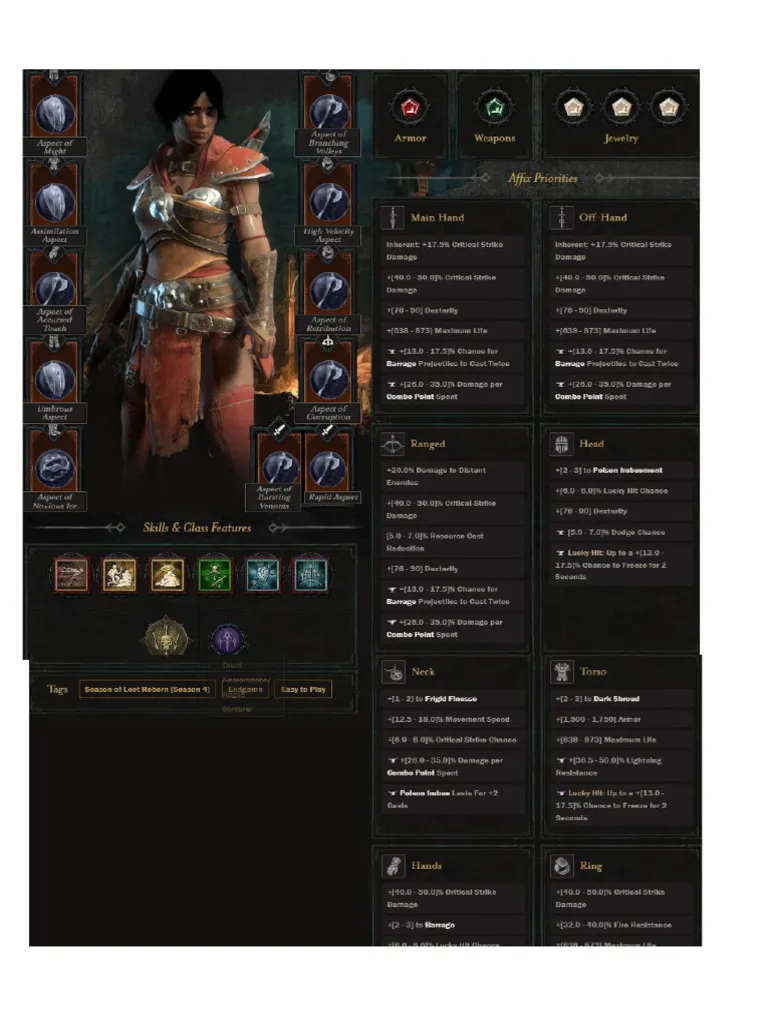
Photo: Diablo 4 character build strategy gear selection endgame planning, via imgv2-1-f.scribdassets.com
There's a comfortable lie that runs through the Diablo 4 community, and most players believe it without ever questioning it: the idea that committing fully to one build is the path to maximum efficiency. Pour every resource into one setup, master it completely, push it as high as it'll go. Sounds logical, right?
It's not wrong, exactly. But it's incomplete. And for a significant number of players, that incomplete thinking is the reason they hit a wall around Pit 75 and can't figure out why their character feels stuck.
Here's the argument that nobody wants to make: running a two-build roster—one speed-farm specialist and one boss-killer—is almost always the smarter long-term strategy. And it costs less than you think.
The Hidden Costs of One-Build Specialization
Let's talk about what actually happens when you go all-in on a single setup for an entire season.
The Paragon Ceiling Problem
Every build has a Paragon ceiling—a point where additional board investment stops producing meaningful returns. For most meta builds, that ceiling arrives somewhere between 150 and 200 Paragon points. After that, you're chasing marginal improvements: a slightly better affix roll here, a small damage multiplier there. The returns flatten dramatically.
Players who recognize this ceiling pivot their playtime toward content that's actually rewarding at their current power level. Players who don't recognize it keep grinding the same dungeons wondering why their character isn't getting stronger.
Content Mismatch Is Real
Diablo 4's endgame has different content types that favor different build archetypes. Speed-farm builds—high mobility, strong AoE, fast cooldowns—are exceptional at clearing Nightmare Dungeons and farming Helltides efficiently. Boss-killer builds—high single-target DPS, strong defensive cooldowns for sustained fights—are what you actually need for Uber bosses and high Pit tiers.
Running a pure speed-farm build into an Uber boss fight is like showing up to a marathon in sprint shoes. You're not wrong about the gear—you're wrong about the application. The inverse is equally true: boss-killer builds clear packs painfully slowly, making routine farming feel like a chore.
Patch Nerfs Land Without Warning
This one is simple and brutal. If your entire season investment lives inside one build and that build gets adjusted in a mid-season patch, you're starting over. Not tweaking—starting over. Players who maintain two builds have a fallback. They can shift their primary focus while the community figures out how to rebuild the nerfed setup, then return to it later with less urgency.
We've seen this happen multiple times in Diablo 4's seasonal history. It will happen again.
The Two-Build Roster: What It Actually Looks Like
The immediate objection is gear. Running two builds means farming twice as much gear, right? In practice, no—not if you're smart about it.
Choose Builds With Overlapping Stat Priorities
This is the key insight. Many builds within the same class share core stat priorities. A Rogue speed-farmer and a Rogue boss-killer both want high critical strike chance, attack speed, and dexterity scaling. The difference is in which skills they slot and which Legendary Aspects they imprint. Jewelry, in particular, often transfers directly between setups.
Cross-class examples of high-overlap roster pairings:
- Necromancer: Bone Spear (boss-killer) + Bone Spirit speed-farm variant. Both use intelligence scaling, critical strike, and essence management gear.
- Sorcerer: Chain Lightning (speed-farm) + Ice Shards (boss-killer). Both prioritize cooldown reduction and mana efficiency rolls.
- Barbarian: Whirlwind (speed-farm) + Hammer of the Ancients (boss-killer). Both use fury generation and physical damage rolls on weapons.
The gear overlap isn't perfect, but it's substantial enough that you're not running two completely separate farming operations. You're running one farming operation that feeds two setups.
The Swap Cost Is Lower Than You Think
For most class pairings, swapping between builds requires changing three to five item slots and re-imprinting two or three Aspects. If you keep a second gear set in your stash—which only requires one or two extra storage tabs—the actual swap time is under three minutes. That's not a meaningful cost.
The Paragon board is the bigger consideration. Some builds require meaningfully different board routing, and respeccing costs gold that adds up over time. The solution here is to choose build pairings that share Paragon board priorities in their first two boards, then diverge in the later optional boards. Most players never fully optimize their fourth and fifth Paragon boards anyway—those are exactly where you can afford to branch toward your secondary build's requirements.
The Counter-Argument (And Why It Doesn't Hold)
The strongest case for one-build specialization is depth of mastery. There's genuine value in knowing every nuance of a single setup—the precise rotation, the optimal positioning for each skill, the gear priority order that most players get wrong. That mastery translates into performance.
But here's the thing: you can achieve mastery in two builds. Especially when those builds share mechanical DNA. A Rogue player who deeply understands positioning and cooldown timing will apply that knowledge across both their speed-farm and boss-killer setups. The mechanical skills transfer. Only the specific skill interactions change.
The argument that maintaining two builds dilutes your focus only holds if you're treating each build as a completely foreign system. Choose complementary setups, and you're not dividing your attention—you're deepening your understanding of your class's full toolkit.
The Practical Starting Point
If you're currently running a single build and want to start building a two-build roster without disrupting your current progress, here's the lowest-friction approach:
- Identify your current build's primary weakness—is it slow clearing speed, or weak single-target damage?
- Find a second build within your class that addresses that weakness while sharing your current gear's primary stats.
- Start keeping duplicate jewelry pieces and weapons in your stash when they drop, rather than salvaging everything.
- When you feel your current build's progression plateau, spend one session experimenting with the secondary setup instead of grinding the same content.
You're not abandoning your main build. You're insuring it. And in a game where patches shift the meta and content types demand different strengths, that insurance is worth more than most players realize until they need it.