Fool's Gold: The Most Overrated Legendaries That Actually Make Your Build Worse

Photo: diablo 4 legendary item tooltip comparison showing misleading stats versus actual performance, via www.actualidadmotor.com
Fool's Gold: The Most Overrated Legendaries That Actually Make Your Build Worse
We need to talk about the elephant in the room: some of Diablo 4's most impressive-sounding legendary items are complete traps. These aren't just "okay" items that get outclassed later—these are actively harmful pieces that make experienced players weaker the moment they equip them.
You know the feeling. You find a legendary with a description that sounds absolutely broken, get excited, equip it immediately, and then... your clear speed tanks. Your survivability plummets. Everything feels worse, but the tooltip looked so good!
Time to expose the biggest offenders and save you from these expensive mistakes.
The "Sounds Amazing, Plays Terribly" Hall of Shame
Melted Heart of Selig - The Ultimate Noob Trap
Why It Sounds Good: "Gain +30% Maximum Resource. Your Resource drains instead of taking damage."
Holy grail of survivability, right? Wrong. This unique chest piece is the poster child for misleading descriptions.
Why It Actually Sucks:
- Resource drain scales with incoming damage, meaning high-tier content empties your resource pool instantly
- Most builds rely on resource for damage, so taking damage literally prevents you from fighting back
- The 30% resource bonus doesn't offset the drain in meaningful content
- Forces you into resource generation builds instead of optimal damage builds
What to Use Instead: Any rare chest with Life, Damage Reduction, and +Skills. Boring? Yes. Effective? Absolutely.
The Grandfather - The Overhyped Disappointment
Why It Sounds Good: It's THE legendary two-handed sword. The name alone screams "endgame weapon." Plus, the raw damage numbers look incredible.
Why It Actually Sucks:
- Lacks aspect slots, meaning you lose crucial build-defining effects
- High damage range doesn't compensate for missing multiplicative bonuses
- Forces you into basic attack builds instead of skill-based builds
- Most endgame builds scale through aspects, not base weapon damage
What to Use Instead: A well-rolled rare two-hander with the right aspect. You'll deal more damage and have more build flexibility.
Ring of Starless Skies - The Caster's False Promise
Why It Sounds Good: "Each consecutive Core Skill cast reduces the Resource cost of your next Core Skill by 8%, up to 40%."
Sounds like infinite casting for Sorcerers and Necromancers, right?
Why It Actually Sucks:
- The resource reduction doesn't stack high enough to matter in real gameplay
- Takes up a ring slot that could have crit chance, crit damage, or vulnerable damage
- Most optimized builds already solve resource problems through other means
- The "consecutive" requirement breaks during normal combat flow
What to Use Instead: Any ring with offensive stats. Resource management should come from your build, not your jewelry.
Doombringer - The Damage Illusion
Why It Sounds Good: Massive damage bonus against elites and bosses. Perfect for endgame content, right?
Why It Actually Sucks:
- The damage bonus only applies to basic attacks, not skills
- Most builds do 90%+ of their damage through skills, not basic attacks
- Missing aspect slot kills build synergy
- The shadow damage proc is negligible compared to proper skill scaling
What to Use Instead: A rare one-hander with appropriate aspects. Your skills will hit harder than this "legendary" basic attack boost.
The Aspect Trap Categories
"Defensive" Aspects That Make You Squishier
Aspect of Might: "Basic Skills grant 20% Damage Reduction for 2-5 seconds."
The Problem: Requires using basic skills regularly, which interrupts optimal rotations and actually reduces your DPS uptime. Real defense comes from killing things faster or avoiding damage entirely.
Better Alternative: Aspect of Disobedience for consistent damage reduction that builds through normal gameplay.
"Damage" Aspects That Reduce DPS
Aspect of Retaliation: "Distant enemies have an 8% chance to be Stunned when they hit you. You deal 25% increased damage to Stunned enemies."
The Problem: Requires taking damage to proc, and the stun chance is too low to be reliable. You're literally building around getting hit, which is the opposite of good gameplay.
Better Alternative: Any aspect that increases damage proactively rather than reactively.
Class-Specific Trap Items
Necromancer: Trag'Oul's Corroded Fang
The Trap: "Blood Lance pierces and deals 10% reduced damage per enemy hit."
Why It Fails: Blood Lance builds want to hit multiple enemies, but this dagger punishes you for doing exactly that. The piercing effect sounds good until you realize your damage falls off a cliff in dense packs.
Smart Alternative: A rare dagger with Blood Lance damage bonus and proper offensive stats.
Barbarian: Ancient's Oath
The Trap: "Steel Grasp launches 2 additional chains. Enemies hit by Steel Grasp are Pulled to you."
Why It Fails: Steel Grasp isn't a main damage skill in any viable build. This two-hander wastes your weapon slot on utility that doesn't translate to clear speed or survivability.
Smart Alternative: Any two-hander that boosts your actual damage skills.
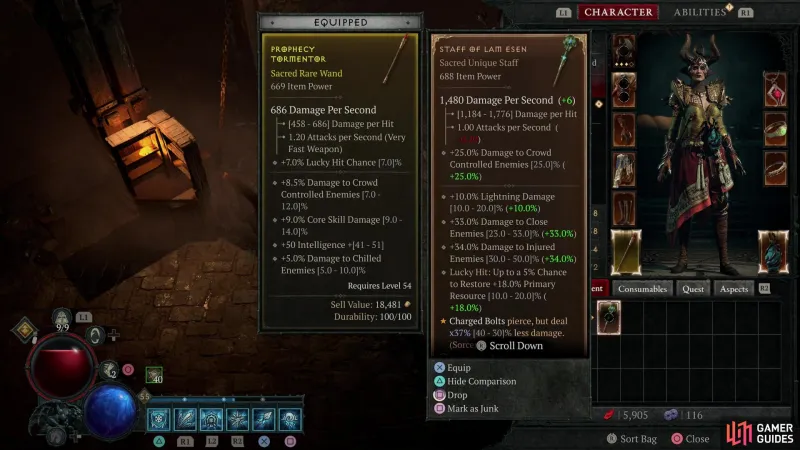
Sorcerer: Staff of Lam Esen
The Trap: "Charged Bolts pierce, but deal 25% less damage."
Why It Fails: Charged Bolts is already a weak skill, and reducing its damage by 25% doesn't help. The piercing effect doesn't compensate for the damage loss.
Smart Alternative: A staff that boosts actually viable Sorcerer skills like Ice Shards or Chain Lightning.
The Psychology of Legendary Traps
Why do these items fool so many players? It comes down to a few psychological factors:
Big Numbers Bias: Humans naturally gravitate toward large numbers, even when smaller numbers with better scaling would be superior.
Unique Item Prestige: We assume rarer items must be better, ignoring the fact that rare items with perfect stats often outperform uniques.
Tooltip Tunnel Vision: We read what an item does in isolation, not how it fits into our overall build ecosystem.
Sunk Cost Fallacy: Once we've invested in an item (especially an expensive one), we resist admitting it was a mistake.
The Red Flags to Watch For
Avoid items that:
- Require you to take damage to function
- Force you to use suboptimal skills
- Scale with basic attacks instead of core skills
- Have overly complex conditional requirements
- Reduce your damage in exchange for marginal utility
Prioritize items that:
- Amplify what your build already does well
- Provide unconditional bonuses
- Scale with your main damage skills
- Offer multiplicative rather than additive bonuses
- Simplify rather than complicate your gameplay
The Testing Protocol
Before committing to any legendary item, run this quick test:
- Baseline Test: Clear a familiar dungeon with your current gear and time it
- New Item Test: Swap in the legendary and repeat the same dungeon
- Performance Comparison: If your clear time increased or you died more often, the item is a trap
- Build Adjustment: Try minor build changes to accommodate the item
- Final Verdict: If you can't match your baseline performance, scrap the item
The Bottom Line
Diablo 4's legendary items aren't automatically better than well-rolled rares. In many cases, they're significantly worse because they lock you into suboptimal gameplay patterns or force you to sacrifice crucial stats.
The most successful endgame players understand this truth: your build defines your gear choices, not the other way around. Don't let flashy tooltips derail a working build.
Stick to gear that amplifies your strengths rather than covering for weaknesses. Your clear times, survivability, and overall enjoyment will improve dramatically once you stop falling for these legendary traps.
Remember: in Diablo 4, boring gear that works beats exciting gear that doesn't. Every time.